On Sunday afternoon when the conference had finished I headed to Temple Meads to catch the train home. Walking along the docks, I was taking a last look at this area of Bristol where I’d never been to before but had spent the weekend. From the distant colourful terraced houses and what looked like allotments that stacked up on the hillside to the left of Brandon Hill and the Cabot Tower, to the docks I was walking alongside. However with the thoughts from two days of talks and experiences still circling my mind, I was strangely alarmed.
One of the first wildlife crimes I think I was told about when I was a kid is that no one can kill a swan. It’s a bit odd how I remember this, perhaps because I was very young and with it being a well recognised species, but it obviously made an impression on me. As I watched them, unlike my normal reaction which is just to make an acknowledgement, images and accounts from some of the conference talks suddenly came to mind. From the issues involving fishing hooks cutting into them, an accidental but nevertheless careless act, to the x-ray we were shown after one had been shot and the case when 46 were found shot dead within just one area. Something so recognised by all and popular in urban areas yet still threatened by persecution.
Wildlife crime can happen anywhere. Whether it’s a rural or urban place. This was presented throughout the weekend at the Birders Against Wildlife Crime’s ‘Eyes in the Field’ conference in Bristol, starting off with some personal accounts from David Lindo, the Urban Birder. Someone who focuses his time observing urban wildlife and shares that enjoyment and importance with others to inspire them too. I really enjoyed his talk. His enthusiasm was relatable to when I’m out in my city centre watching the peregrine falcons at the cathedral. I often go down, at least once a week, and can spend hours standing around with my binoculars. Across the UK, as Keith Betton told us in his talk, peregrines are doing great in urban areas as their numbers have boomed. However even though they’re considered ‘safer’ here they still face threats. I’ve had a few first hand accounts of this with the pair in my local city centre. A very recent one made some national news and was mentioned a few times over the weekend. This was about a racing pigeon that had been found in a nearby garden with a hook tied to its feet. Another was when a very healthy looking peregrine, one we presume was from the cathedral, was found dead on a nearby school playing field.
From the enjoyment of watching these birds on a regular basis and being fascinated by them, to learning of what some think is acceptable to do which could, and is in other areas, causing incredible harm wakes you up. It motivates you and this was so rightly put by Craig Jones, wildlife photographer, in his talk. His message being we all have motivation to do what we do, fighting against wildlife crime. In his talk whilst showing a selection of simply fantastic images he spoke his mind and of his passion which was an extremely powerful combination and set a lot of the audience to tears. As well as this he gave some very well deserved praises to Birders Against Wildlife Crime and Mark Avery. I was very, very pleased to see the BAWC team receiving the award of ‘Wildlife Success Story of the Year’ for the hen harrier from the BBC Countryfile Magazine Awards too. As mentioned, this was not necessarily to do with bird numbers as they are still very much endangered but public awareness and understanding of the issue has soared.
It goes without saying how important public awareness is. Spreading the message far and wide educates those who didn’t know before about the injustice which is going on. With this they may take action by perhaps showing their face at events or on social media, telling others or even just being aware of what goes on, able to recognise this then report. The theme of reporting and being eyes in the field was mentioned by many speakers and is an important motto of BAWC. Without being outside, recognising then reporting wildlife crime nothing will happen to prevent it from taking place and catching the criminal. Bob Elliot, RSPB Head of Investigations, shared an example about a lady who reported a golden eagle she found dead. She wasn’t exactly a wildlife expect but she’d been told about these sorts of crimes in a talk a few years back. Spreading the message is a vital ingredient however in some cases doing this can be an issue. On Sunday morning the fantastic Mike Dilger opened the second day of the conference and spoke about how wildlife crime is all too often seen as ‘turn off TV’ therefore not broadcasted. His presenting on The One Show reaches a very broad audience, from those who may have interests in the environment to those who have little knowledge of it. Although he told us that including pieces about wildlife crime can be difficult, Mike explained how it is becoming a much more common thing on our TV screens. He even showed us two examples which were a piece on The One Show with peregrines and on Inside Out about deer poaching.
In the clip about deer poaching on Inside Out, forensics at the scene examined the ‘unwanted’ parts of the deer that the poachers left at a road side. They were able to extract human DNA from the animal which was very useful in tracking down who had committed the crime. This put part of what Dr Louise Robinson and her third year student Sally Smith, both from Derby University, had spoken about on Saturday into visual context. Obviously investigating the killing of an animal is going to be different to that of a humans. However this use of forensics is used in a very similar way with a similar purpose which is fascinating stuff and quite exciting in the development of advancing the ways in which wildlife criminals can be caught.
Going back, another type of media and method of spreading the word which was spoken about a lot over the weekend was the use of social media. Someone who was really promoting it was Sargent Rob Taylor in his talk. I’ve followed him on Twitter for quite some time and when I heard he was going to be speaking at BAWC I was quite excited. Just by reading his tweets and dedication to the account you can tell how committed he is to stamp out wildlife crime. The work him and his rural policing team in North Wales has done is incredible and has been so successful, overall in the past eight years they have reduced wildlife crime by 84%. Something even more incredible would be if other police forces in the UK could follow suit but unfortunately that isn’t completely the case just yet. If you take a look at his account you’ll see that throughout the day he tweets about everything from incidents he’s dealing with to giving his followers an opportunity to ask him questions.
As well as the ongoing success story of North Wales, another celebration of the weekend was about the National Wildlife Crime Unit. After the all-too-close threat of this vital unit shutting down completely a few weeks back, it has now been secured until 2020. A talk was given by Ian Guildford from NWCU about how their work goes hand in hand with that of wildlife crime officers by obtaining and distributing information from a wide range of organisations and by assisting police forces in wildlife crime investigations. Many of the speakers went through case studies and examples of what they have to deal with, for some these are on a daily basis. And of course all were infuriating examples, why would anyone begin to think of doing such things. But that’s the thing, they’re examples and as Geoff Edmond, RSPCA, questioned, are there more issues then we realise? Putting the word ‘wildlife’ before ‘crime’ doesn’t make the crime invalid or different to any other offences. Therefore it shouldn’t be acted upon or treated any differently.
Depending on the nature of the crime or how it’s responded to could mean the specie involved isn’t dead but does need urgent care. Preventing further suffering was the key theme of the wonderful Pauline Kidner’s talk. I first properly met Pauline last September at The Badger Trust conference, she is such a lovely lady who does incredible things to help wildlife when in need within her area of the South West. The incidents she spoke about weren’t all related to wildlife crime but many were and she told us about some pretty horrific things she’s had to deal with. From badgers being shot, stuffed in bin bags then dumped to a deer that had been hit by a car and had the back half of its body ripped away. She really does have a first hand experience from these dealings. In her talk, Pauline also spoke about next generations and their understanding and consideration for nature. A very articulate point she made was about young people being able to play shooting games without hesitation to what it actually means as they turn it off and then turn it back on again another time, and everything’s back to normal.
Birders Against Wildlife Crime are very enthusiastic and interested in inviting young people to their conference and other events as well as encouraging them to be the next generation of eyes in the field. This year they managed to get hold of more sponsors to allow more young people to attend as their ticket costs were covered. This is such a big help as for many, including myself, without it they probably wouldn’t of been able to attend the conference. For a student still in education I simply can’t afford it. Therefore being encouraged and supported to go along to events like the BAWC conference is brilliant. Not only making it accessible for more youngsters to come and bring fresh faces, but spreading the message amongst next generations. These are the ones who will be required to carry on the work of protecting nature in years to come to prevent further terrible consequences. Education is the key and unfortunately we do face some battles as young people are influenced by what they see on the TV or on the internet from an early age. Some do believe it. Not only this but the growing disconnection from nature, and organisations that send out almost entirely opposite messages whilst visiting schools, for example the Countryside Alliance. Growing awareness amongst younger generations is just, or if not more so, important then older ones. Lets hope next year there’s even more youngsters at BAWC17!
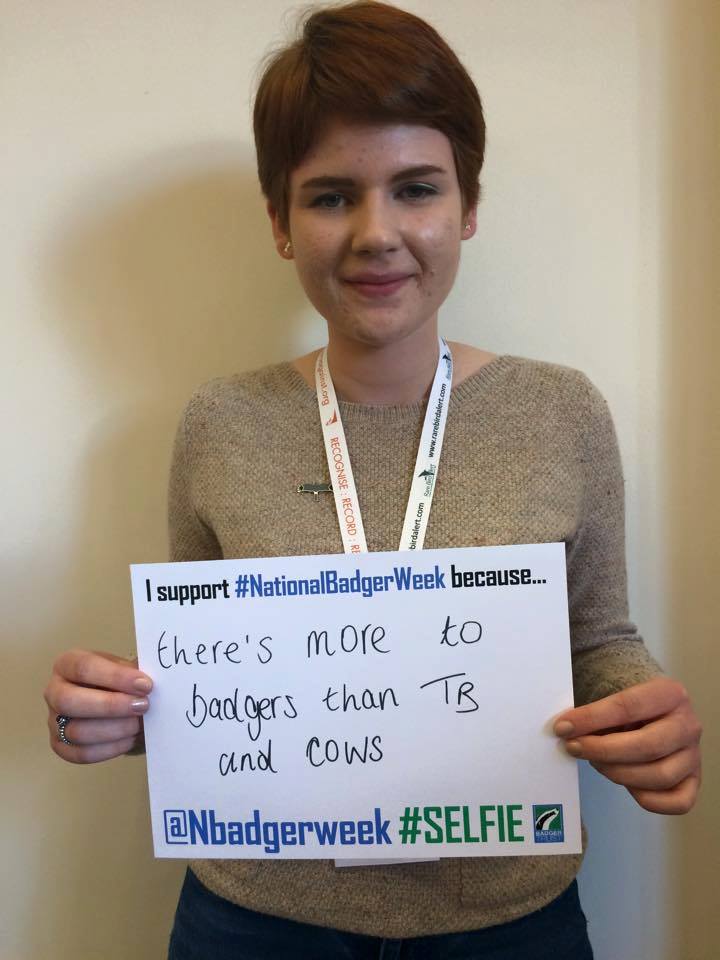
One campaign that got into schools across the country last year and spread a positive message about a national treasure was National Badger Day with their short film. The day was nothing to do with what is all too often linked to badgers, e.g. the cull, but for the specie they really are. A fabulous striking creature which has lived in the British Isles for thousands and thousands of years. This year the day has been prolonged and changed around a bit by becoming a week and moving to the end of June. The number of activities, engagement and popularity is also hopefully going to grow with a lot more going on. Over the weekend they began to start it all off with a selfie opportunity – ‘I support #NationalBadgerWeek because…’ then photos are and hopefully more will be shared across social media in the coming weeks and months. Below is my contribution.

Unfortunately the media’s presentation of badgers is almost always linked to either TB, cows or the cull. Too many think of a badger then think about TB or cows when in fact badgers aren’t to blame, therefore don’t deserve this.
On day two of the conference it was a bit of a badger bonanza with many of the speakers giving a mention to badgers and discussing crimes associated with them. From Mike Dilger pronouncing his opinion of the cull to Geoff Edmond, RSPCA, talking about badger digging incidences and Ian Guildford, NWCU, who stated that badger baiting is amongst those wildlife crimes they focus on. Many will know that badgers are amongst the most persecuted animal in the UK. Even with the Protection of Badgers Act 1992 in place, thousands are still persecuted each year and suffer terribly in the process. They have a real tough time as tens of thousands are also killed on roads each year and of course the ignorant cull. However, again, public awareness has been a massive step forward in protecting this species which has been tied up in a political ball game. This has been from many individuals, organisations, charities (etc) but someone who has led a way has been Dominic Dyer. I’ve mentioned him quite a few times on my blog before from the talks he’s given on marches, all equally as eloquent as the speech he gave to mark the end of the BAWC conference 2016.
After Geoff Edmond from the RSPCA finished his talk he held up his glass of water. What does it show? There was a silence before someone answered with ‘it’s half full’. Obviously, keep positive was his message from this. Which is very true. Another point I enjoyed from one of the speakers, who I can’t remember, was that if you compare current day wildlife crimes to 40/50 years ago there are certain issues which no longer occur. For example, egg collecting. Just like many wildlife crimes today, it’s a trend which originated from many years ago, but is now almost none existent. Let us hope this is the case with other crimes against wildlife in the near future. As Mark Avery so rightly said, we will win!





 Georgia Locock