As you may have seen from my latest blog last Friday night I filmed some badger cubs at a local sett for the first time this year. The Saturday before I had set my cameras up and there was no sign of any cubs so when I filmed them on the following Friday night that was obviously one of the first times they’d emerged from the sett this year.
I was very pleased with the footage as not only is it extremely cute but it shows a variety of behaviour. From the cubs playing and fighting with each other to a few clips of the adult badgers having a comical scratch. As I didn’t get back from the Badger Trust Seminar until late on Saturday I put my trail camera back up on Sunday evening then collected it before school the next morning. It was great to collect it before school as it was a fantastic start to the day due to it being a beautiful morning, there were swallows about and I was really excited to see what I got on my trail camera!
Once again it was good stuff. This time I’d put the camera lower down so the cubs were much more curious and I managed to get some great footage.
It’s also really interesting to compare my footage to that I got this time last year. A year ago, almost to the day, I filmed three cubs at the same sett so they were a bit later then this year but not much. You can see last years footage by clicking here.
Here’s some of my favourite clips from last weekend –
After collecting my trail camera I was thrilled to see that not only had I filmed the adult badgers but I had also filmed badger cubs for the first time this year! I set my camera up near the sett last Saturday and there was no sign of cubs so this was obviously one of the first times they had emerged from the sett. I was thrilled with the footage, It was fantastic to see the natural behaviour of badger cubs exiting the sett for one of the first times. I filmed a variety of activity from cubs playing, the adults having a good scratch and one of the adults dragging one of the cubs back in to the sett by the scruff of its neck. Here’s one of the clips, I’ll be doing a blog post with more later on in the week.
I didn’t have that much time to look through as I had a long journey ahead of me to the Badger Trust Seminar in Bristol. As I was eager to go and my parents were working I managed to get a lift from a member of the South Derbyshire Badger Group which was great and I was so pleased I went! There was a prompt start at 11 for the AGM then after lunch the afternoon of debates began.
First debate – The Badger Cull
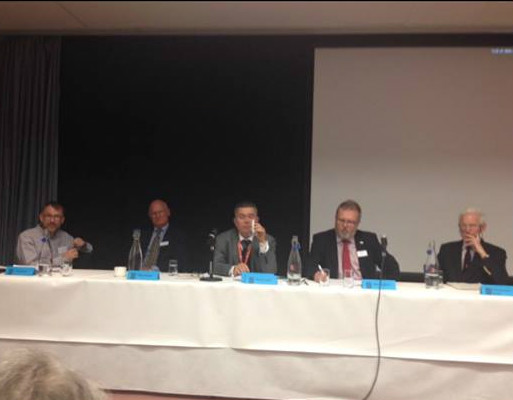
The first debate was on the badger cull. Sat on the panel was Professor John Bourne, the Chairman of Independent Scientific Group, Roger Blowey, Livestock Vet, John Blackwell, President of British Veterinary Association and Mark Jones, Vet and Wildlife Protection Campaigner. As you can see, from the variation of panel members, it was very interesting and resulted in a fantastic debate with a mixture of discussion from the panel and comments from the audience. This debate was very important as it’s not very often you get people like this together. Before comments from the floor the members of the panel introduced themselves and give a small introduction then Dominic Dyer, Badger Trust CEO, asked them a question on what they had said.
However before long this got a bit out of hand and the debate became very intense. For me it was a great experience and to hear so many people express their opinion in such a strong way, against the cull, was truly inspiring. Also the fact that they weren’t afraid to speak out against those on the panel which are in favour of the cull.
The first to speak was John Blackwell, President of British Veterinary Association. This was interesting as the British Veterinary Association had released their statement on the badger cull just a few days before the Seminar. In the statement they had made a U-turn from their original idea which was culling free running badgers was the way to go. Instead, in their latest statement, they stated that the pilot culls should continue but badgers should be caught in cages before shot as they believe it’s a ‘humane and effective’ way.
This was then followed by Roger Blowey, a recently retired Livestock Vet and author of report on the possible impact of culling lowering TB rates in cattle. I’ve read comments from him in many articles stating the fact that he believes ‘the culling of badgers in the county is the only reason why farmers are now testing negative for bovine TB for the first time in a decade’. Roger Blowey made many more comments and suggestions like this one throughout his introduction and in the debate.
Without a doubt, this fired the debate up. Many people in the audience got involved which was timed nicely with the great introduction from Professor John Bourne. It was obvious he knew what he was talking about as he destroyed any scientific, economic or animal welfare justification for the current badger cull policy. He went into great detail, along with giving examples from other countries, that the negligence and deceit within the Government, Farming and Veterinary Industry has led to the demonisation of badgers for spreading bTB when all the evidence points to poor bTb testing and cattle controls as a key factor for the increase in Btb. He also stated how millions of pounds has been wasted, wildlife destroyed and how farmers and tax payers have been let down by a disastrous bTb reduction policy which has focused on badgers far too much.
The last one to speak was Mark Jones who is a vet and wildlife protection campaigner. His introduction went through different reasons why the cull isn’t and won’t work. He presented his points in a very organised way and put his points across clearly. He also made the very valid points on how badger persecution is rising which is no doubt related to the badger cull.
Overall it was an extremely interesting and tense afternoon, I was very pleased to be there. Obviously, as you all know, I’m against the cull, full stop. So being there during the debate was a fantastic experience. The atmosphere was incredible and I felt privileged to be surrounded by people that care so passionately. Going to an event like this makes me realise, more so, why I am against the cull and makes me more determined to help do my bit to rule it out and resort to other ways to reduce bTb.
Second debate – Wildlife Crime
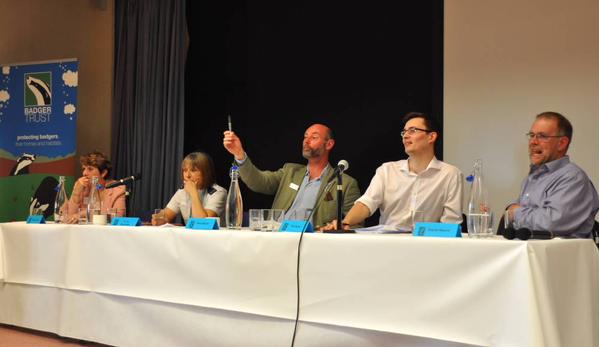
The afternoon didn’t stop there though as there was another debate which was on wildlife crime. I must say, this debate wasn’t as intense but it was still very interesting. The panel was chaired by the new Badger Trust chairman, Peter Martin, and on the panel was Charlie Moores, Birders Against Wildlife Crime, Tom Quinn, Director of Campaigns at League Against Cruel Sports, Pauline Kidner, Founder of Secret World Wildlife Rescue and Lee Bainbridge who is the wildlife Crime Officer from the area.
Starting it off was Charlie Moores who is the Chair of Birders Against Wildlife Crime. He gave a summary about what BAWC is about, his views on wildlife crime and tackling wildlife crime. Birders Against Wildlife Crime is a campaign group which was set up last year by a group of experienced birders and conservationists who are sick of the number of crimes being committed against wildlife. I went along to BAWC’s first conference a few weeks back which was a fantastic day and you can read more about it by clicking here.
This was followed by Tom Quinn who is the director of campaigns at League Against Cruel Sports. He spoke about how reducing wildlife crime is a massive priority for The League, wildlife crimes including fox hunting and badger persecution, increased promotion of wildlife crime on social media, how the badger cull is having an impact on badger persecution and how wildlife crime data is uncoordinated and underfunded. He also spoke about the work The League do and convicting the wildlife criminals.
For this debate, most likely due to the fact that we all had mutual feelings, it was more organised and the speakers had the chance to speak before the debate. Next up was the wildlife crime officer for Avon and Somerset, Lee Bainbridge. She spoke about reporting wildlife crime, the role and increase of wildlife crime officers and how the training is improving. I think the talk from Lee Bainbridge could relate to most of us as if you’re one for being outdoors and observing wildlife you come across wildlife crimes. I came across one which had been committed at a badgers sett last year and got in touch with my local wildlife crime officer and the Badger Trust. Fortunately the result was very good.
Before the audience could ask questions there was one more talk which was from the Founder of Secret World Wildlife Rescue, Pauline Kidner. She spoke about the increase of injured badgers which is linked to the cull, wildlife traps and snares and reporting and recording wildlife crime. Another thing she spoke about was something that she believes is important that we need to do to help tackle wildlife crime and that is by starting with educating the youth. I was pleased she brought this up as it’s a subject which is also very important to me.
When I go to school I’m surrounded by young people that have no idea about the ongoings in our countryside. This is partly to do with things like technology which have taken over. If young children aren’t able to go out and engage with the outdoors from a young age and learn about it when they grow up then how are they supposed to be able to report wildlife crime, help protect species and habitats, and most of all put their opinion across on what they think should be going on in the countryside and to our wildlife, without being brainwashed.
This debate was different to the one on the badger cull as everyone on the panel had mutual feelings. However there was a lot of discussion about the problems with reporting wildlife crimes and how it isn’t being taken seriously enough. There was also a discussion about fox hunting and the illegal on goings which aren’t dealt with.
After a fantastic day it was finished perfectly with a talk from the actor and animal ambassador, Peter Egan. He gave his comment from the discussions which had gone on and read out a very inspirational poem about Moon Bears.
As I’ve been off for the last two weeks I’ve made the most of it and tried to get out as much as I can. Whether it be on my local patch, nature reserves or setting my trail camera up. Unfortunately I have some important exams approaching so I’ve had to make time to revise for them too.
However a few nights ago I returned back to a badgers sett which I hadn’t filmed at since last Autumn. This time last year I managed to film a few of the adults but it wasn’t until the end of the month when the cubs first appeared. When I collected my trail camera on Sunday morning it was pretty much the same, adults but no cubs yet. I set two cameras up, one of my normal ones that I use and a new one which my Dad has been working on recently. It works through something called a Raspberry Pi, not an actual pie but a type of computer. He then added the camera, motion detector and then printed out a case with his 3D printer. It’s very clever and it was great to try it out for the first time. Unfortunately It didn’t go completely to plan but he’s made some adjustments and we’re going to set it up again soon.
Here’s some of the footage I got. It includes badgers and a tree climbing rat. I hope to film the cubs in the upcoming weeks.
Yesterday was a strange day. When I went to bed on Saturday night, I was very pleased after watching some badgers at a local sett, wondering what I’d get on my trail camera and curious into what the result of the vote in Malta about spring hunting would be. For some reason it seemed obvious to me that they’d vote ‘NO’ for many different reasons. For example the terrible consequences it has on the decline of many birds, whether it’s in Malta or wherever the bird is migrating to, the other wildlife affected, the fact that forests have been wiped out or maybe the fact that Malta seems to be referred to as the place with this disgusting slaughter of birds. The list of reasons voting ‘NO’ is endless.
I was up nice and early yesterday morning to collect my camera, eager to see what I had filmed and wandering if the cubs had appeared yet. I was very pleased with the footage. Unfortunately no cubs just yet but they shouldn’t be long now.
After looking through all my footage I refused to get ready to go out before I found out the result of the vote for the spring hunting in Malta. I sat patiently at my laptop screen. Refreshing every minute or so on Twitter and reading through all the articles that were published. It was very tense as I think, along with many others, that ending the slaughter of birds in Malta is essential.
Malta is a small island in the middle of the Mediterranean Sea. It isthe natural place for exhausted birds to rest as they make their long migrations between Africa and Europe. These birds are an easy target for the 10,000 bird hunters that occupy the countryside of Malta and each year countless birds are shot out of the sky in spring and autumn. Spring hunting is especially damaging to wild birds because these are the birds which have survived the winter in Africa and are flying back to Europe to nest and provide the next generation of birds.
The spring hunting of quail and turtle dove is an activity which is banned across Europe but still remains in Malta. According to the hunter’s own report, 4,131 turtle dove and 637 quail were shot during the spring season of 2014.
The turtle dove has become increasingly rare following rapid population declines. The species is now included on the Red List of conservation concern meaning there are concerns that the species could become extinct in the UK within a decade. That’s just in the UK. There has been a 70% decline of these birds since the 1970s. One of the reasons because of this is due to hunting. They also hunt the birds during the Autumn but this doesn’t have as much impact as during the spring as then they are travelling to breed. Hunting these birds on their way to breeding grounds results in not only one bird dying but their offspring too.
Furthermore, a bird will reproduce every year, say for at least five years and hence the number of unborn chicks is multiplied. This results in the destruction of a whole generation. For example, if 4,131 birds were shot dead last Spring alone. So, say each bird raised five young over five years, excluding the fact the birds will be male and female and turtle doves also have problems with breeding due to habitat and food loss, that’s 20,655 unborn chicks over five years just from the birds shot in the 2014 spring hunting season. It is estimated that only 14,000 pairs breed in the UK every year. Now if you compare them figures it’s pretty obvious that the Spring hunting is having a massive impact on the decline of turtle doves, not just in the UK but for the species as a whole.
Then when the birds are travelling back for the Winter, away from Europe, the birds that did survive and their offspring could be shot anyway. They have no chance.
But turtle doves aren’t the only species that’s suffering. As I stated before, the spring hunting is targeted at turtle doves and quail. Common quail are also in decline. But, as well as shooting these birds, many Maltese hunters also use the spring hunting as an opportunity to target rare and protected species of birds that breed in Europe, such as Pallid Harriers, Cuckoos and Bee-eaters. The hunters like to pretend that the problems with shooting birds is only affecting Malta but this isn’t the case. Many of the birds targeted by hunters are the subject of big international conservation projects to increase their numbers where they breed. Other bird species are in fact not breeding in Malta simply because they are either being killed or because they are scared away by the continuous shooting. Along with this, sound pollution also disturbs other animal species that breed in the spring.
I hope you can see that the spring slaughter of thousands of migrating birds is disgusting. How hunters can go out and shoot down migrating birds, which don’t even belong to Malta, and get pleasure from that along with knowing that not only turtle doves and quail are in rapid decline but so are many of the other birds they shoot which fly over. If this doesn’t stop then we will see birds becoming extinct.
Malta made the wrong decision yesterday morning. The spring hunting will go on. The persecution of birds which are becoming missing from European countries will continue. For me, along with many others, this was terrible news. The hunters really have no idea. When will they realise what they are doing and stop. I hope that this happens before it becomes too late. I’ve never seen a turtle dove yet the hunters in Malta may see a flock go over during the spring hunting season and shoot them all dead with no guilt or understanding whatsoever.
However it isn’t all bad news. People in Malta do want this slaughter to end. The margin of victory was tiny – 50.44% to 49.56%.
This isn’t the end though. Fantastic charities and organisations made this referendum happen and they won’t give up. They’ve got this far and we won’t give up either. Two of these charities are SHout and BirdLife Malta.
If you would like to help or get involved you can
Write to your local MEP and ask them to support this urgent call for action to stop spring hunting in Malta – click here
Share the word about the campaigns of SHout and BirdLife Malta. Perhaps on Facebook or Twitter, with the hash tag #stopspringhunting
Join BirdLife Malta and support their work for birds and nature in the Maltese Islands.
Whilst on Twitter and reading the articles about the referendum in Malta yesterday morning it was fantastic to see so much support, especially from fellow young people. However I did see some comments about boycotting Malta. I don’t think boycotting Malta is the answer. Yes we are angry, so am I but we need to use our anger wisely and turn it into a positive energy. As you can see a lot of people in Malta are against the spring hunting and they have some fantastic charities against it too. It doesn’t help that the Government in Malta are pro the hunting. I think the best option is to work with them and help where we can. By making ourselves heard, shouting above the noise and not giving up, we will win.



 Georgia Locock